How does the precise heating control of a mould temperature controller shorten the moulding cycle?
In injection moulding, many manufacturers attempt to shorten production cycles by increasing machine speeds, reducing cooling times, or raising production targets. While these measures may offer some assistance, they often introduce a hidden risk: reduced process stability, which can lead to fluctuations in product quality. This is precisely where mould temperature controllers become indispensable.
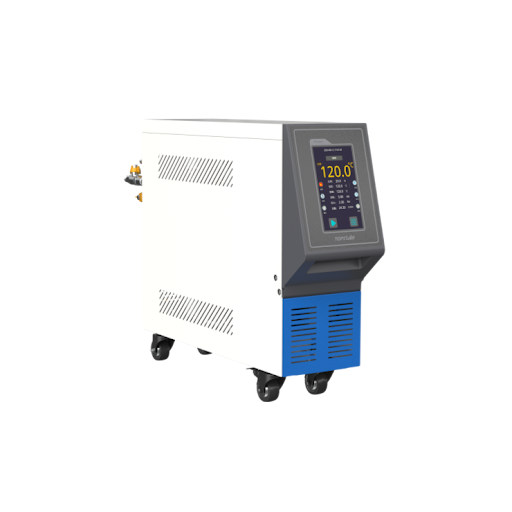
As a Product Manager at Topstar, I believe precise heating control is one of the most effective ways to shorten injection moulding cycles without compromising quality. It involves more than just heating the mould; it entails creating a stable thermal environment that allows the resin to fill the mould cavities more predictably, cool more uniformly, and reach ejection conditions more rapidly.
Mould Temperature Controller Enables Faster and More Stable Thermal Start-ups
A production line does not truly begin with the first acceptable part, but rather with thermal stabilization. Before an injection moulding machine can produce parts of consistent quality, the mould must reach its optimal temperature and maintain it. If this process is overly time-consuming, the production line loses valuable operational time before it can even commence normal-volume production.
Mould temperature controllers efficiently accelerate the mould’s approach to its target temperature, thereby shortening the start-up phase. Precise heating control is critical because a mould does not heat up like a simple solid block of metal; it comprises intricate channels, cavities, plates, and components with varying thermal capacities. Consequently, certain areas will heat up faster than others. If the heating system lacks the precision to respond accurately to these variations, the mould surface may appear to have reached its target temperature, while the internal temperature remains uneven.
Mould Temperature Controller Improves Resin Flowability, Enabling Faster and More Uniform Mould Filling
The injection moulding cycle depends not only on the cooling rate but also on the speed and uniformity of resin filling the mould cavities. If the molten resin encounters resistance—due to an overly cold mould or uneven heating—the injection moulding machine must work harder to force the material into the cavities. This often compels manufacturers to increase injection pressure, extend filling time, or compensate by prolonging the holding-pressure phase.
By precisely regulating heating, the mould temperature controller maintains the cavity surface temperature within a range that facilitates smooth resin flow, thereby effectively preventing the aforementioned issues. When the mould temperature is optimal, the molten resin retains its fluidity longer and fills the cavities more uniformly. This means the machine completes the filling phase more easily and quickly.
Reduce Cooling Imbalance and Shorten Waiting Times Before Ejection
In most injection moulding processes, the cooling phase consumes the majority of the cycle time. Once the mould cavities are filled, the parts must cool sufficiently so they can be ejected without deformation. Precise heating control is critical during this process. Maintaining stable, well-controlled mould temperatures at the start of the moulding cycle often determines the parts’ cooling efficiency at the cycle’s conclusion.
If mould temperatures are unstable, part cooling becomes uneven. Some areas solidify too quickly, while others remain excessively hot. This imbalance generates internal stresses that can lead to warping, sink marks, or dimensional instability. To avoid these defects, operators typically extend the cooling time. Even a slight increase in cooling time—when accumulated over thousands of cycles—can significantly reduce production throughput.
Reduce Scrap Rates and Prevent Production Cycle Extensions Caused by Defects
Cycle time cannot be measured solely by the machine’s internal clock. A part produced with a short cycle time offers no true gain in production efficiency if it ultimately becomes scrap. In many manufacturing facilities, the root cause of persistently high cycle times is operators deliberately extending production times to mitigate defects. They do this because unstable temperature conditions create risks of surface defects, dimensional errors, or deformation.
Mould temperature controllers, equipped with precise heating control capabilities, help reduce defects at the source. When the mould is maintained within the correct temperature range, process repeatability is significantly enhanced. This consistency improves part quality and eliminates the need for unnecessary, time-consuming “protective” process adjustments.
Enable Shorter Production Cycles in Thin-Wall and Precision Applications
Not all moulded parts share the same characteristics. Some parts are relatively thick and possess high process tolerance. In contrast, others are thin-walled, structurally complex, and highly sensitive to temperature fluctuations. Thin-wall products, precision enclosures, electrical housings, and functional components all impose stringent demands on temperature control systems. In these scenarios, a mould temperature controller becomes particularly vital for achieving shorter production cycle times.
Thin-wall parts cool rapidly, but they also require rapid filling—leaving very little margin for error. If the mould temperature is too low, the resin may freeze off before the cavities are fully filled. Conversely, if the temperature is unstable, the parts may require longer holding times or slower moulding cycles to prevent defects. This defeats the very purpose of high-speed production. Precise heating control enables the mould to operate within a narrower, more effective temperature range. This improves flowability during the filling process and minimizes premature solidification. Consequently, the injection moulding machine can complete the moulding process more easily, thereby reducing the need for additional safety margins.
Shortened Moulding Cycles and Attainment of Target Temperatures
The precise heating control provided by the mould temperature controller shortens moulding cycles by optimizing the overall thermal dynamics of the production process. It facilitates the mould in reaching its target temperature more rapidly, supports smoother resin flow, mitigates cooling imbalances, reduces defect rates, and enables the injection moulding machine to operate within a more stable and efficient process window.