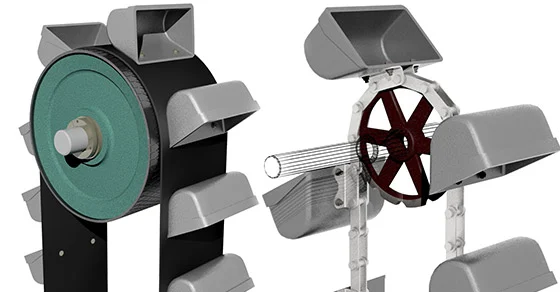
Centrifugal vs. Continuous Bucket Elevators: Design Differences
When plant engineers sit down to specify vertical material handling equipment, one of the earliest and most consequential decisions involves discharge method. It is a detail that rarely gets discussed outside engineering circles, yet it fundamentally shapes how a bucket elevator performs with a given material. Centrifugal and continuous designs represent two distinct approaches to solving the same basic problem, and understanding the mechanical differences between them can save plant operators from selecting equipment that looks fine on paper but underperforms once it is handling real material day after day.
How Centrifugal Discharge Actually Works
Centrifugal bucket elevators rely on speed and momentum to fling material out of the buckets at the top of the cycle. As buckets travel around the head pulley, they are spaced closely together and moving fast enough that centrifugal force throws the material outward into the discharge chute. This design works particularly well with free-flowing, non-abrasive materials like grain, small aggregates, or dry powders that release easily from the bucket without sticking or clumping. A TONGLI Bucket Elevator configured for centrifugal discharge typically runs at higher speeds than its continuous counterpart, which allows for impressive throughput when handling the right type of material. The tradeoff is that this speed becomes a liability with heavier, stickier, or more irregular materials, since they may not discharge cleanly and can end up spilling or clogging the system.
Understanding Continuous Discharge Design
Continuous bucket elevators take a fundamentally different approach, using a slower speed and buckets that are spaced further apart with a distinct shape allowing material to flow out gently rather than being flung by force. As each bucket passes over the head pulley, it essentially uses the bucket ahead of it as a guide, allowing material to slide smoothly into the discharge chute without relying on momentum. This gentler handling makes continuous designs ideal for heavier, more abrasive, or fragile materials where excessive speed would cause spillage, product damage, or accelerated wear on system components. Cementl frequently recommends continuous discharge configurations for cement clinker and similar dense materials, since the controlled, lower-speed movement significantly reduces the mechanical stress that heavier materials place on buckets, chains, and casings over time.
Comparing Performance Across Different Materials
The practical differences between these two designs become most apparent when you consider how various materials behave during the lifting and discharge process. Free-flowing grains and light aggregates tend to perform beautifully in a centrifugal bucket elevator, taking full advantage of the higher speeds to maximize throughput without creating spillage problems. Heavier or stickier materials, on the other hand, often struggle in a centrifugal system, since insufficient force or improper bucket fill can lead to material clinging to bucket walls rather than discharging cleanly. This is precisely where continuous designs shine, since the slower, more controlled movement allows even sticky or irregular materials to release properly without relying on speed alone to force separation. A TONGLI Bucket Elevator built for continuous discharge often becomes the preferred choice in applications involving damp, clumpy, or unusually shaped materials that simply do not behave well under high-speed centrifugal force.
Maintenance and Mechanical Stress Considerations
Beyond material compatibility, the two discharge methods also differ meaningfully in terms of long-term mechanical wear. The higher operating speeds inherent to centrifugal systems place additional stress on bearings, chains, and drive components, which can shorten service intervals if not properly maintained. Continuous systems, running at lower speeds, generally experience less mechanical stress over time, though they typically require more careful attention to bucket spacing and alignment to maintain proper discharge flow. Cementl often points out that neither design is inherently superior in a general sense, since the right choice depends entirely on matching discharge method to material characteristics and production goals rather than assuming one approach works universally better than the other.
Making the Right Choice for Your Application
Deciding between centrifugal and continuous discharge ultimately comes down to a clear-eyed assessment of the material being handled and the production environment. Facilities running lightweight, free-flowing products often find that a centrifugal bucket elevator delivers excellent throughput without unnecessary complexity, while operations dealing with heavier, abrasive, or moisture-sensitive materials tend to benefit far more from the gentler handling continuous designs provide. Consulting with an experienced manufacturer who understands these mechanical tradeoffs, rather than defaulting to whichever configuration happens to be readily available, leads to far better long-term equipment performance.
Conclusion
Choosing between centrifugal and continuous discharge is not a decision to make lightly, since the wrong choice can lead to spillage, excessive wear, or equipment that simply cannot keep pace with production demands. Whether you are evaluating a TONGLI Bucket Elevator for a grain facility or a heavier industrial application involving cement or mineral processing, understanding these fundamental design differences helps ensure the system you choose actually matches the material it needs to handle. For plants navigating this decision, working with knowledgeable manufacturers like Cementl provides the technical insight needed to select a bucket elevator configuration built for genuine long-term success.