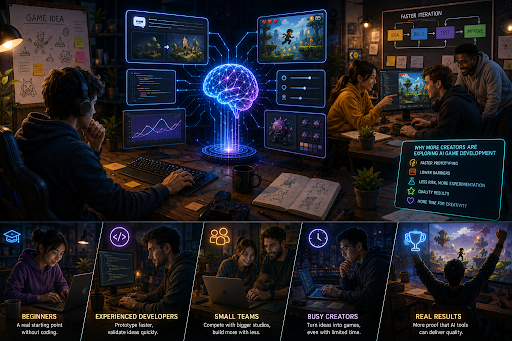
Why More Creators Are Exploring AI Game Development
A few years ago, AI game development was a niche curiosity, something a small group of early adopters experimented with while most creators stuck to familiar, traditional tools. That’s changed noticeably. A much broader range of creators, from complete beginners to experienced developers, are now genuinely exploring what AI-assisted development can offer them, and the reasons behind that shift go deeper than just following a trend.
The Shift From Curiosity to Genuine Consideration
Early Skepticism Has Given Way to Real Evidence
The first wave of AI-assisted game tools faced reasonable skepticism about whether they could produce anything genuinely good. That skepticism has softened considerably as more creators have seen real, polished results come out of these platforms, evidence tends to move people more than promises do, and there’s now enough of it to take seriously.
Word of Mouth Among Creators Has Grown
As more individual creators share their own experiences building with AI-assisted tools, other creators who might not have considered it are hearing directly from peers rather than just marketing material. That kind of peer-driven credibility carries more weight than any feature list.
Why Different Types of Creators Are Exploring This Now
Beginners Looking for a Realistic Entry Point
People who’ve always had a game idea but no technical background are increasingly finding that AI game development gives them an actual, achievable starting point, rather than requiring years of learning before they could test whether they’d even enjoy the process.
Experienced Developers Looking to Move Faster
Even creators who are fully capable of traditional coding are exploring AI-assisted tools for prototyping specifically, since validating whether an idea is fun doesn’t require the same technical investment as building a polished final version. Games like Planet Destroyer show what this kind of fast, iteration-heavy process can produce, a satisfying, well-tuned core loop that likely benefited from testing several directions quickly rather than committing to a single slow, manual build.
Small Teams Wanting to Compete With Larger Studios
Solo creators and small teams are exploring these tools specifically because they narrow the production gap that used to separate what a small group could build from what a large studio with more resources could produce. That competitive motivation is drawing in creators who might otherwise have stuck with slower, more resource-intensive traditional approaches.
Hobbyists With Limited Time
People with full-time jobs and genuine creative interest, but limited hours to dedicate to a side project, are exploring AI-assisted development because it makes finishing something realistic within the time they actually have available, rather than requiring a commitment that competes with their existing responsibilities.
What’s Actually Drawing Creators In
The Speed From Idea to Playable Version
No-code game maker platforms let creators go from a description to a working prototype almost immediately, which removes the single biggest reason creators used to hesitate before starting: the uncertainty of investing significant time before knowing if an idea has any real potential.
Lower Risk in Trying New Directions
Because testing a concept costs relatively little time and effort, creators exploring AI-assisted development feel freer to try ideas that might not work out. That lower-stakes environment for experimentation is part of what’s drawing in creators who were previously hesitant to commit to unproven concepts.
Evidence That Quality Doesn’t Have to Suffer
A lingering concern for creators considering AI-assisted development has always been whether the results would feel genuinely good or just fast. As more polished, well-received games built this way become visible, that concern is fading, replaced by a growing sense that speed and quality aren’t actually in conflict the way they used to assume.
What Creators Are Finding Once They Try It
The Creative Work Doesn’t Disappear, It Shifts
Creators exploring these tools for the first time often expect the process to feel less creative, and are surprised to find that removing technical implementation just means more of their attention goes directly toward design decisions, pacing, feel, fairness, rather than being split between design and unrelated technical troubleshooting.
Iteration Becomes a Habit, Not a Luxury
Creators used to slower, traditional development often describe a shift in how they approach design once iteration becomes cheap: testing multiple variations becomes the default rather than something reserved for when time allows, which tends to noticeably improve their final results.
The Learning Curve Is About Description, Not Syntax
New explorers of AI-assisted development typically find that the real skill to develop isn’t technical at all, it’s learning to describe ideas clearly and specifically enough that the generated result matches what they actually intended.
Why This Exploration Is Likely to Keep Growing
Results Keep Improving
As the underlying technology continues to advance, the quality ceiling for what AI-assisted development can produce keeps rising, which gives increasingly skeptical or cautious creators fewer reasons to hold back from trying it themselves.
The Barrier to Trying It Is Low
Exploring AI game development doesn’t require abandoning existing skills or tools. Creators can test the approach on a small project without any real commitment, which makes it an easy thing to try even for those who remain genuinely uncertain about adopting it more broadly.
Success Stories Keep Accumulating
As more creators across different backgrounds and skill levels share genuinely successful projects built this way, the accumulated evidence continues to lower the perceived risk for the next wave of creators considering whether to explore it themselves.
Final Thoughts
More creators are exploring AI game development because the early uncertainty about whether these tools could produce genuinely good results has largely given way to visible, accumulating evidence that they can. Beginners are finding a realistic entry point, experienced developers are finding a faster way to prototype, and small teams are finding a way to compete more directly with larger studios.
What’s drawing creators in isn’t a promise of shortcuts, it’s growing confidence that speed and quality aren’t actually opposed, and that the creative work that’s always defined good game design, judgment, taste, honest iteration, remains just as central as it’s ever been, regardless of how the underlying implementation happens.